


PPWR – New EU Packaging
and Packaging Waste Regulations

PPWR – New EU Packaging and Packaging Waste Regulations.
What do you need to know?
Packaging accompanies us at every step – it protects products, facilitates transport, and provides information. But it is also a huge source of waste. According to the European Commission, packaging accounts for around 36% of municipal waste in the EU.
The growing amount of waste, different recycling standards across Member States, and the need to reduce CO₂ emissions led the European Union to prepare new regulations:
PPWR – Packaging and Packaging Waste Regulation.
This regulation will revolutionize the way packaging is designed, produced, and managed across the EU.
What is PPWR?
PPWR is a proposal for a regulation (not a directive), which means it will apply directly in all EU countries – without the need for implementation into national law.
It will replace the current Directive 94/62/EC on packaging and packaging waste, which has been in place for over 25 years and no longer meets the challenges of a circular economy.
Objectives of PPWR
The new law has five main goals:
- Prevent packaging waste generation
- Increase reuse and recycling
- Reduce excessive packaging (“overpackaging”)
- Harmonize regulations across the EU – equal rules for all businesses in the single market
- Increase the share of recycled materials in packaging production
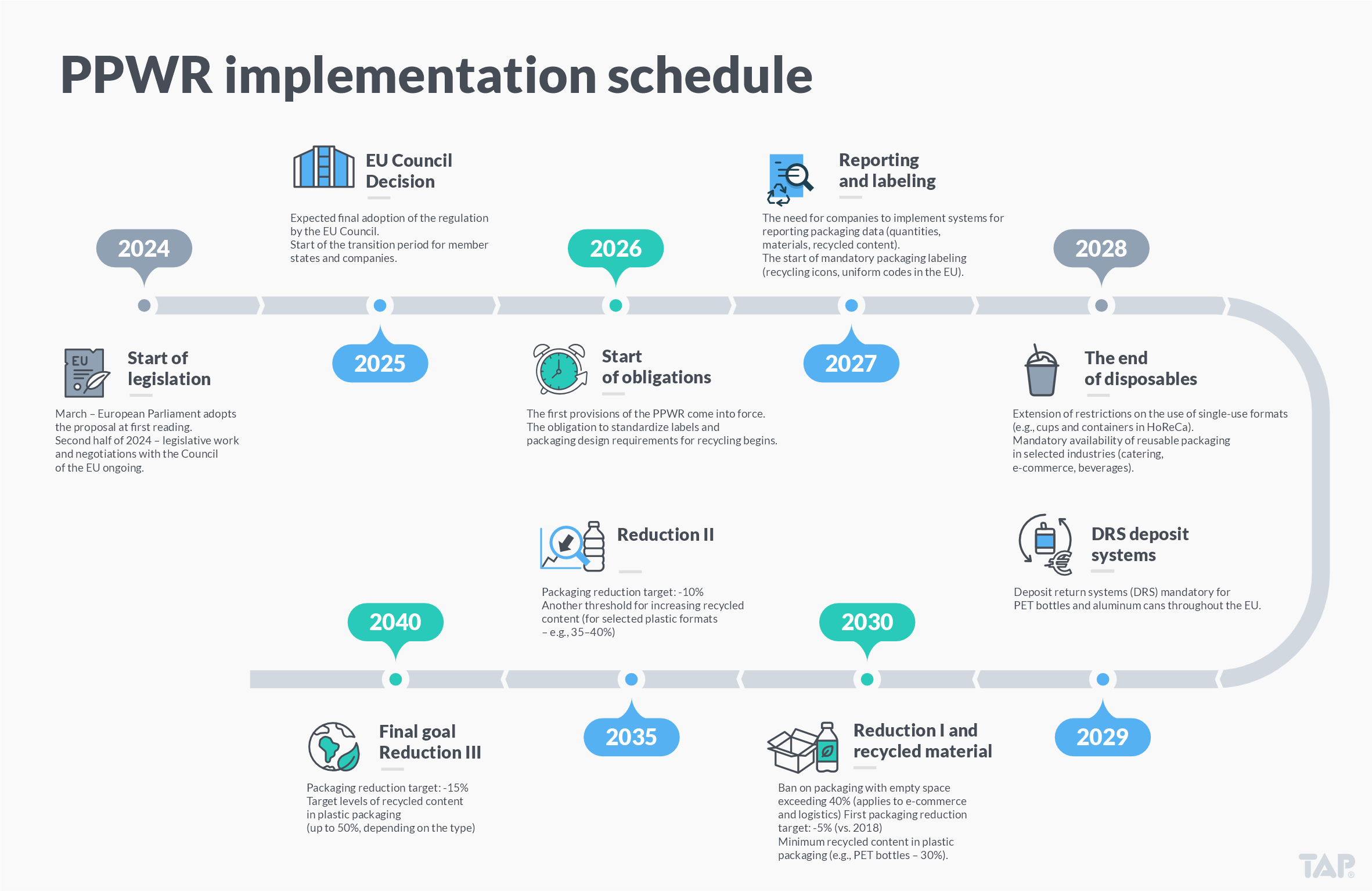
Key principles and obligations
1. Eco-design of packaging
- Standardized labels (clear information for consumers).
- Obligation to design packaging to be recyclable.
2. Bans and restrictions
- Gradual phase-out of single-use formats (e.g., very light plastic bags, single-use packaging for fresh food in HoReCa – from 2030).
3. Packaging reduction targets
- 5% by 2030
- 10% by 2035
- 15% by 2040 (compared to 2018 levels)
4. Minimum recycled content in plastic
- Depending on the packaging type: from 10% to 50% between 2030–2040.
5. Deposit return systems (DRS)
- By 2029, all EU countries will have to introduce a deposit system for PET bottles and aluminum cans.
6. Reuse requirements
- New obligations for the foodservice sector, e-commerce, and the beverage industry regarding reusable packaging.
Who does PPWR affect?
- Packaging manufacturers
- Importers of packaged products
- E-commerce and logistics companies
- Waste collection, sorting, and recycling businesses
- HoReCa and retail sectors
Benefits and challenges
Benefits:
- Less waste and a cleaner environment
- Greater transparency for consumers thanks to standardized labeling
- Easier trade – uniform rules across the EU
Challenges:
- Adapting production lines and logistics processes
- Higher implementation costs (especially in the short term)
- Need for reporting and detailed record-keeping of materials used
What does this mean in practice?
PPWR is not just legislation but a real change in how companies operate:
- E-commerce will have to eliminate excessive packaging and empty space in parcels
- Packaging producers will be required to use recycled content
- Restaurants and foodservice chains will have to implement reusable solutions
Summary and next steps
PPWR is the biggest change in packaging regulations in decades. It will affect manufacturers, retailers, logistics, and consumers. The sooner companies start preparing, the easier and cheaper the adjustment process will be.
In the next article, we will explain what PPWR means for the e-commerce sector and which solutions are worth implementing today to avoid problems in 2026.
If you’d like to talk to the author of this article, you can do so via Linkedin, by filling out the contact form, or by writing to info@taptelion.pl.

Contact us, and we’ll help you navigate PPWR without stress or risk.
Write to us – we will advise you, prepare a design, and deliver the perfect solution for your shipping process.
